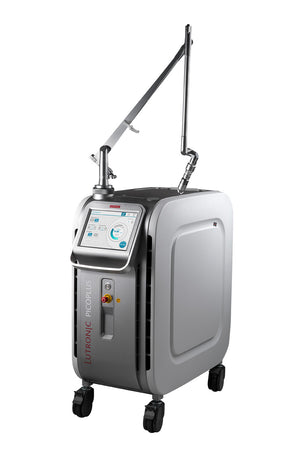
Picosecond lasers have long become standard for modern individuals seeking to improve uneven skin tone, hyperpigmentation, and enlarged pores. However, melanin cells in Asians are highly active, and their faces often present with complex melasma, post-inflammatory red acne scars (post-acne erythema), or clear-bordered freckles and sunspots (lentigines). Facing such multi-dimensional skin challenges, improper selection of laser wavelength and energy can easily lead to post-inflammatory hyperpigmentation or thermal damage. As a professional team specializing in acne scars and precise skin condition management, Geown Dermatology Clinic adheres to the core principle of "evidence-based medicine." The clinic's advanced picosecond laser system, with its multi-wavelength advantages of 1064nm, 595nm, and 532nm and fractional technology, is supported by four authoritative international medical literature sources and is specifically designed for Asian skin types, offering a low-risk, high-efficacy, and precise repair solution.
Can be used for daily skincare or after treatments. Apply an appropriate amount evenly to the skin. Can also be applied thickly to dry or sensitive areas for enhanced repair.
三、 己研皮膚專科的核心優勢:色素、血管與組織重塑的「複合治療學」
在己研皮膚專科,皮秒雷射不只是單一的能量操作,而是將「色素、血管、組織重塑」三者結合的精準醫療流程:
| 治療對象 / 痛點 | 傳統單一皮秒打法 | 己研皮膚專科多波長精準計畫 | 國際文獻支持點 |
|---|---|---|---|
| 頑固肝斑 (Melasma) |
僅用單一波長打黑,容易因熱刺激導致肝斑再度活躍、反黑。 | 1064nm 點陣蜂巢防禦 + 595nm 血管收縮: 打碎黑色素同時穩定血管,大幅降低亞洲人反黑率。 | Randomized Multicenter Trial / Asians Prospective Study |
| 發炎後紅斑 / 紅痘疤 | 依賴時間自然淡化,或使用傳統脈衝光,恢復期較長且容易泛紅。 | 595nm 皮秒微血管精準收縮: 光震波精準狙擊血紅素,快速消退紅疤,不傷周圍正常組織。 | Post-acne Erythema Successful Treatment Study |
| 曬斑與雀斑 (Lentigines) |
使用舊型雷射熱能過高,術後易流血、留下大片黑印(反黑)。 | 532nm 皮秒精準色素粉碎: 利用超短脈寬瞬間震碎黑色素顆粒,清除率高且安全度大幅提升。 | Lentigines Treatment in Asian Skin Study |
| 毛孔粗大 / 面部初老 | 強烈破壞性飛梭,留下面部開放性傷口與冗長流湯恢復期。 | 1064nm 點陣蜂巢養膚: 在表皮完好的狀況下刺激深層膠原蛋白,重塑細緻膚質。 | Skin Rejuvenation in Asians Study |
FAQs
IV. FAQs about Picosecond Lasers
Q: I have Asian skin, with sunspots and freckles of varying sizes on my face. Is 532nm picosecond laser treatment safe? Is there a high risk of post-inflammatory hyperpigmentation?
A: This is precisely the key to the advancement of high-end picosecond laser technology. According to the international prospective medical study "A Prospective Study in the Treatment of Lentigines in Asian Skin Using 532 nm...", it has been empirically proven that using a 532nm picosecond laser to treat superficial pigmentation (Lentigines) in Asian skin is very safe and highly effective. This is because picosecond lasers have a "photoacoustic" characteristic with an ultrashort pulse width, which allows them to shatter melanin in a very short time without generating excessive "residual heat." This means that spots can be cleanly removed, while significantly reducing the likelihood of post-inflammatory hyperpigmentation (PIH) or hypopigmentation, which is a major concern for Asians.
Q: Why does EpiSkin Dermatology emphasize a combined 1064nm and 595nm dual-wavelength treatment for melasma?
A: Because melasma is a complex problem that combines "pigmentation, microvascular proliferation, and skin aging." According to the latest published multicenter randomized double-blind clinical trials, treatment of melasma with 1064nm combined with 595nm dual-wavelength picosecond laser is significantly more effective than traditional topical creams (such as 2% hydroquinone cream). The 1064nm is responsible for gently metabolizing pigments in the dermis and epidermis, while the 595nm is responsible for constricting abnormally dilated capillaries under the melasma and blocking inflammatory signals. This dual-track approach to pigmentation and vascular issues, combined with the skin rejuvenation defense mechanism of the 1064nm fractional holographic handpiece, is currently recognized by the medical community as the gold standard for treating melasma in Asians, offering greater safety and a lower recurrence rate.
